Firelight Protocol brings scalable, data-driven protection to DeFi, enabling onchain cover against defined protocol failures through staked capital, transparent parameters, and independent risk validation.
Firelight Protocol
In 1897, the first auto insurance policy was simply a horse-and-carriage form with the word "horse" crossed out. It took the industry another decade to build underwriting that actually understood cars, instead of running new risk through old paperwork.
DeFi coverage is still in that crossed-out-horse phase: the sector holds roughly $100 billion in total value locked, yet only a fraction of a percent of that capital is protected by onchain cover. As the industry institutionalises further, the protection gap is becoming harder to ignore.
Firelight Protocol is the first DeFi cover primitive. It enables digital asset holders to stake assets while enabling protocols and vaults across DeFi to implement scalable, data-driven protection. Cover parameters are registered onchain and every exploit event is confirmed by an independent Risk Consortium.
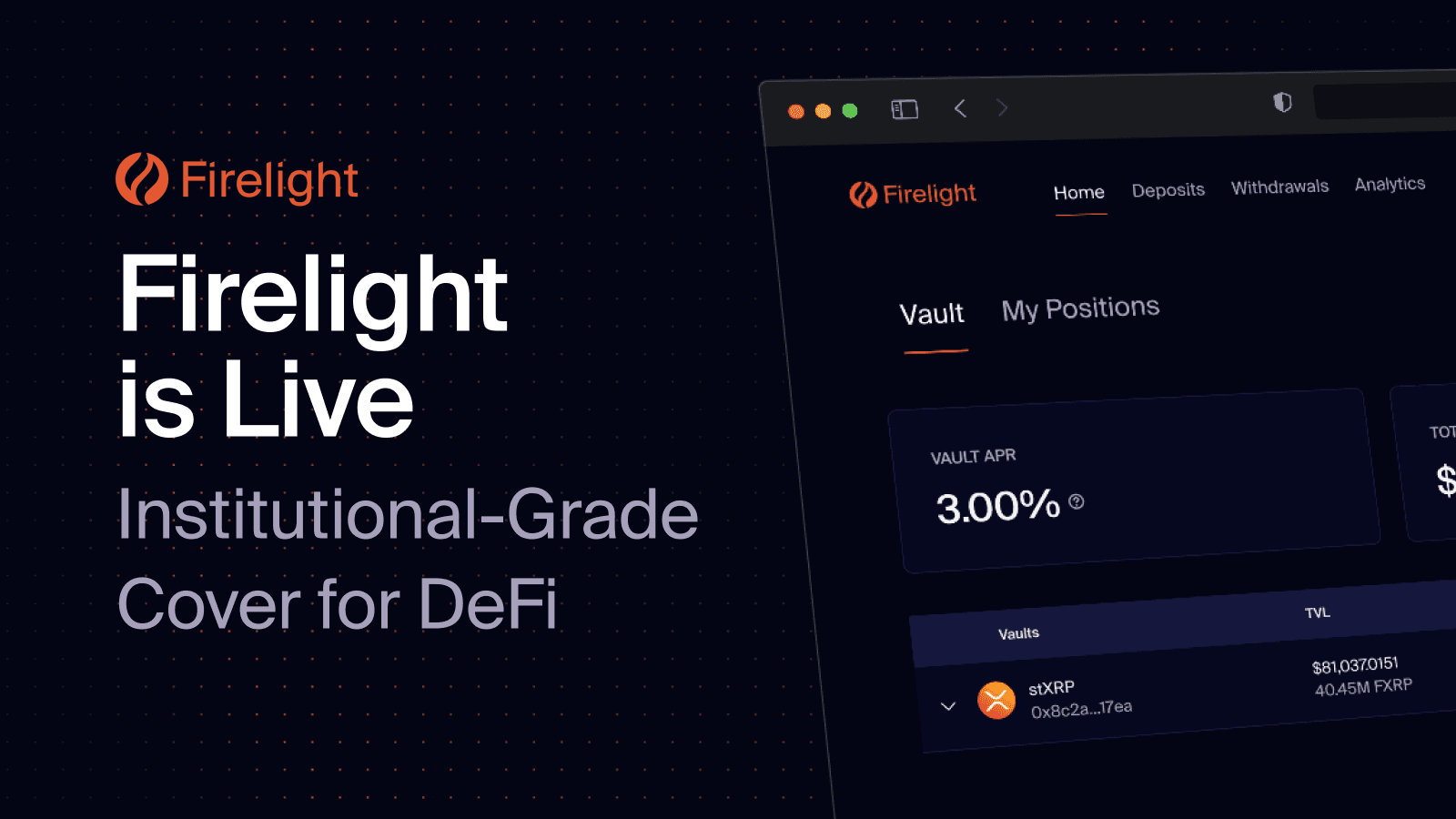
Firelight Protocol is live as of today, launching with initial cover integrations with Sentora’s USD Protected Vault and Protected RWA Vaults. In addition, Firelight is partnered with Veda and Uphift, a leading vault infrastructure provider.
Firelight’s Architecture
Firelight functions as an onchain cover enablement protocol for DeFi. Among the various features that distinguish the Protocol from a contractual or traditional insurance arrangement, the capital supporting the Protocol’s portfolio of elected programmatic cover is provided by participants staking capital to the Protocol, rather than by an insurer assuming a single contractual risk position. The deposit cap for aggregate staked positions is now at $115 million XRP. Firelight registers the parameters, scope, price, and capacity onchain. Eligible technical and economic events are named, and include smart contract exploits, oracle failures, governance exploits, bad debt and depegs from mechanism failure, and redemption failures. As emissions begin to accrue to the protocol and cover is enabled, the unstaking window increases to match the 30-day coverage periods.
When an exploit is confirmed, Firelight programmatically identifies every eligible active position in a covered vault within the affected market. ZeroShadow, Firelight’s designated security partner, publishes an exploit report, and the Risk Consortium independently validates the event, confirms the loss, and publishes an onchain attestation.
How Firelight Protocol Emissions Work
Stakers earn a share of Protocol emissions in return for providing economic security to the Protocol, with their staked capital subject to slashing and serving as the capital that enables the operation of the Protocol’s programmatic cover engine. Emissions are funded by the fees programme operators pay to enable cover on their vaults, and are tied to overall protocol revenue rather than to any individual vault or market. As more cover is enabled across the portfolio, the revenue supporting emissions grows with it.
Emissions are streamed to stakers continuously and denominated in FXRP. Fees paid in USDC convert back to FXRP and flow back into each staker's position, with no separate action required. This auto-compounding increases the redemption value of a staker's position over time. Because that value remains staked, it also remains subject to slashing: in the event of a confirmed cover event, compounded rewards are exposed in the same way as the original contribution. Stakers continue to earn emissions, and remain subject to slashing, until they have fully exited the unstaking queue.
Early Contributor Rewards
Separately, the first Protocol emissions are being distributed to early contributors based on Firelight Points earned through specific actions and activities that contributed to the early development, growth and launch of the Protocol. Eligible addresses will receive a share of this initial emission in proportion to the points earned through those contributions. Further details on eligibility and claiming will be shared through Firelight’s official channels in the coming days.
Integrations Live at Launch
Firelight coverage is embedded into Sentora’s USD Protected Vault and Protected RWA Vaults. The Sentora RWA Vault is designed for strategies centred on real-world assets (RWAs), including leveraged looping and lending across markets where RWAs can be utilized as collateral. The Sentora USD Vault provides diversified access to USD-denominated strategies executed fully onchain across established DeFi protocols.
With Firelight coverage embedded at the vault level, these strategies can operate with an additional layer of verifiable, onchain protection against defined protocol failures. Further, Firelight is partnered with Veda to integrate Firelight protection at the vault infrastructure layer.
Firelight’s Risk Consortium
The Firelight Risk Consortium is a five-firm independent panel, made up of Hypernative, Native, Credora, Cyfrin, and GFX Labs, that reviews every cover event before a payout can be released by the protocol. Each event is validated against published coverage criteria and authorised through transparent onchain attestation rather than a centralised adjuster.
Firelight's own contracts are audited by OpenZeppelin, Coinspect, and 0xMacro, with a completed public bug bounty through Immunefi.
Built on Strong Foundations
Firelight is incubated by Sentora and developed and maintained by Sentinel Labs. The Firelight Protocol is underpinned by Sentora's risk infrastructure, which applies more than 1,000 proprietary risk models across $2 billion in deployed assets and more than 300 monitored strategies. With $8 million in seed funding led by Gumi Cryptos Capital, with participation from Maven 11, Metalayer, and Tribe Capital, the early commitment reflects institutional conviction in the need for onchain cover, well ahead of today's launch.
Firelight's coverage parameters, vault details, and cover processes are now live. Full documentation on how exploit validation and payouts work is available here.